Land Grab
NYSE: FPH

Public markets have an incredibly difficult time valuing land banks. This isn't surprising given that these projects tend to last decades, and cash flows 20+ years out aren't worth much in a DCF.
One of my subscriber friends (@thewritser on X) recently pointed out an interesting grant at Five Point Homes (NYSE: FPH). What follows is an email reply I sent to him analyzing this particular grant. writser did the heavy lifting on this one, and what follows builds upon his great insights.
The grants in question were made on September 3, 2025: CEO, CFO, and COO
Size of the grant: historic RSU grants have been smaller than the ones they just gave (~half as large). Counteracting this is the fact that their stock price was generally lower in those years, so that the total value of the RSU probably isn't that different overall. The CEO minimum payout on the current grant would be ~$2.3MM and the maximum payout would be ~$22.5MM. The CEO's salary is ~$700K with another ~$3MM in equity compensation yearly. The recent proxy shows that he owns ~270K shares outright and holds another ~1.7MM unvested shares overall (some subject to time and some subject to price conditions). Overall, the dollar amount of the grant is quite significant at the higher end of the payout range.
Wording of the grant: this is the first time that they explicitly call out the share price targets. Previous ones did not disclose the actual share price targets in the Form 4, but they did eventually disclose them in the Def 14A proxy doc. These hurdles are very high and seem to be a stretch goal for management.
Vesting of the grant: The 20% vesting based on the different share price hurdles is interesting mostly because it doesn't really pay them much if they only reach the lowest hurdle. From a stock price perspective though, that lowest hurdle is a double in the stock price. I'd argue that this grant is almost not worth it to the CEO (for example) if he only hits a couple of the lower price hurdles.
Vesting of the grant during a change of control: This wasn't disclosed in the Form 4, but historically speaking, this is the wording they've disclosed in the Def 14A: "In the event that a Change in Control occurs prior to the vesting date and the PSUs are not assumed or substituted for in the Change in Control transaction, then the unvested PSUs shall vest immediately prior to the Change in Control at the target level of performance. If the unvested PSUs are assumed or substituted for in such Change in Control transaction, the target level of performance shall be deemed to have been achieved and such PSUs shall vest on the original vesting date. If a Change in Control occurs and an executive’s employment is terminated without Cause or by the participant for Good Reason on or after the effective date of the Change in Control but prior to 24 months following the Change in Control, then any unvested PSUs shall become fully vested at the target level of performance.". This seems to imply that the share price hurdles don't matter if there's a change in control and their awards aren't replaced.
Timing and characteristics of the grant: It looks as though they've done similar grants in the past, but the threshold premium is much higher this time around. They usually grant them in March, so departing from the typical schedule is a significant tell.
Sample of the CEO's grants:
March 9, 2023. (Stock was at $2.23)
295,964 time-based RSUs.
394,618 performance-based RSUs. Threshold share price was $3.30 (47% premium) and target share price was $6.30 (182% premium).
June 8, 2023. (Stock was at $2.39)
58,670 performance-based RSUs to "replace a portion of a previously granted award that was canceled not for value earlier this year". This is based on other corporate milestones, and I largely ignored this.
March 8, 2024. (Stock was at $3.02)
218,543 time-based RSUs.
291,390 performance-based RSUs. Threshold share price of $4.10 (35% premium) and target share price of $7.10 (135% premium).
Sep 3, 2025. (Stock was at $5.59)
1,000,000 performance-based RSUs. Price hurdles of $11.50 (105% premium), $14.25 (154% premium), $17.00 (204% premium), $19.75 (253% premium) and $22.50 (302% premium). 20% vesting based on each hurdle met.
Performance period of the new grant: Kind of odd that it's from Sep 3, 2028 until Sep 3, 2030. Not sure why they would want it to start three years from now. Historically, their performance-based RSUs had a three-year performance period that would start on the date of the grant.
Mix of the grant: Historically, the CEO's grant has been approximately half time-based RSUs and half performance-based RSUs. This one is 100% performance-based RSUs. That is a bullish change.
Investor presentation: Given that this is the company’s first investor presentation, I think this is an interesting change. As you pointed out, the presentation seems to be pretty credit focused and likely has to do with their recent debt refinancing.
10-Q wording changes:
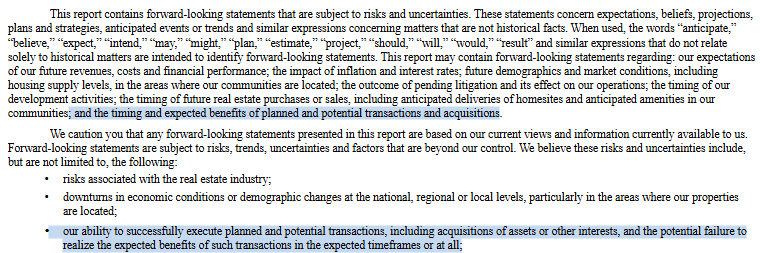
These are material additions for sure. My feeling is that these were added because of the Hearthstone transaction, but it may relate to something else.

The increase was $3.4MM overall. Hearthstone was purchased for ~$56MM. Common real estate acquisition/disposition costs are 1-4% of the purchase price depending on a lot of factors. At an estimated amount of 3% of the purchase price, this would imply ~$1.6MM in selling costs. That leaves almost another ~$1.8MM in "other growth opportunities". If we only take into account the $1.8MM, that would still be a ~15% increase. Definitely significant, especially when they say it's to pursue "other growth opportunities".
Overall, there's definitely something here. The 10-Q changes seem to imply that they are looking at buying something significant. Usually, I would consider that a negative given that doing good acquisitions is hard. In this case, they wouldn't have granted themselves all this equity just to blow a bunch of money on an acquisition that would crater the stock price 20% tomorrow. Historically, they have achieved the lowest price hurdles in the performance-based RSUs, so why would this grant be any different!
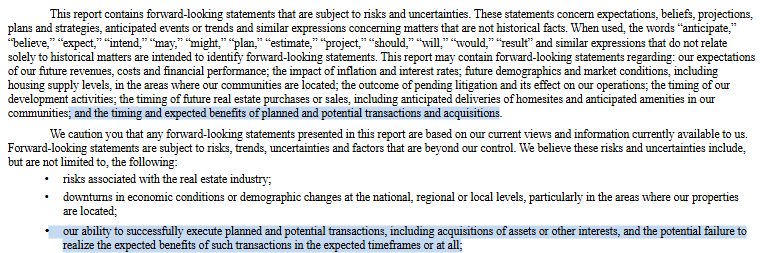

I agree with you. A plausible scenario is them beginning to return capital to shareholders given that the new debt has much less restrictive covenants. This is a lever that is completely in management’s control and would likely result in a significant rerating of the stock price. Land banks, after all, generally trade at a discount because investors tend to think that they won’t return capital for a very long time.
FPH's accounting is complicated, and their ownership of these projects is mostly in GP/LP's, with various participation rights. @marginofdanger on X has put guesses out there of NAV being $10-15 per share. Robotti has said they think it is worth "many multiples" of the ~$4.00 per share it was trading at in Jan 2025 (presentation link).
While it’s possible to narrow it down to a specific number, I don't need a scale to know that someone’s fat.
PS: I keep conversations with subscribers confidential unless they specifically give me consent to write up an idea. Always happy to take a look at something and provide individual feedback.